Field Trips
Tipton-Haynes State Historic Site offers a wide variety of options for field trips that will provide your students with a day of educational fun. Tipton-Haynes encourages teachers and their students from all grade levels to come and enjoy our site and history. A tour of the Tipton-Haynes home and the limestone cave is required for all field trips. Depending upon the number of students per field trip, two to four of the historic-based activities can be selected per trip.
Upon arriving at the site, each field will be broken into smaller groups and will rotate through the various activities chosen. It is requested that each group will have at least one adult chaperone. Three to four hours will allow you and your students ample of time to complete each activity. Students and chaperones should dress comfortable per the weather and should wear appropriate shoes for exploring the cave and woods. Your group is encouraged your to eat lunch on site once all activities are completed.
The cost per student is $6; teachers and chaperones are free. We request your payment in full upon arrival. Reservations for field trips are made on a first come, first served basis and are required to be made at least two weeks in advance. For reservations, more information, or questions, email us or call 423-926-3631.
Activities Offered
There are several activities to choose from per grade level when planning your field trip. Click on an option for more information on what is provided.
HISTORIC BASED ACTIVITIES
-
Historical Significance
An early type of lighting was torches made from pine-knots. Candles were made from tallow or animal fat. Wicks were made of loosely spun hemp or tow or of cotton. Sometimes wicks were made from the silk found in the fall in the milkweed pod. Candles were either dipped or molded. Beeswax was used for making candles and later when oil was discovered in the mid-1800s paraffin was used to make candles. An early type of lamp was the Betty-lamp. The hollow part of the lamp was filled with tallow, grease, or oil with a piece of cotton rag or coarse wick. The flame was smoky and ill-smelling. Oil lamps that were used in the 1800s gave a much brighter light than candles.
How Candle Dipping Relates to Tipton-Haynes
Early settlers such as the Tiptons relied on the fireplace for warmth and light. They also had access to oil lamps. By the time the Haynes family lived in the house during the mid 1800s, in addition to oil lamps, candles enabled them to have light at the end of the day. Candles were traditionally made in the fall when the days were cooler.
Student Activity
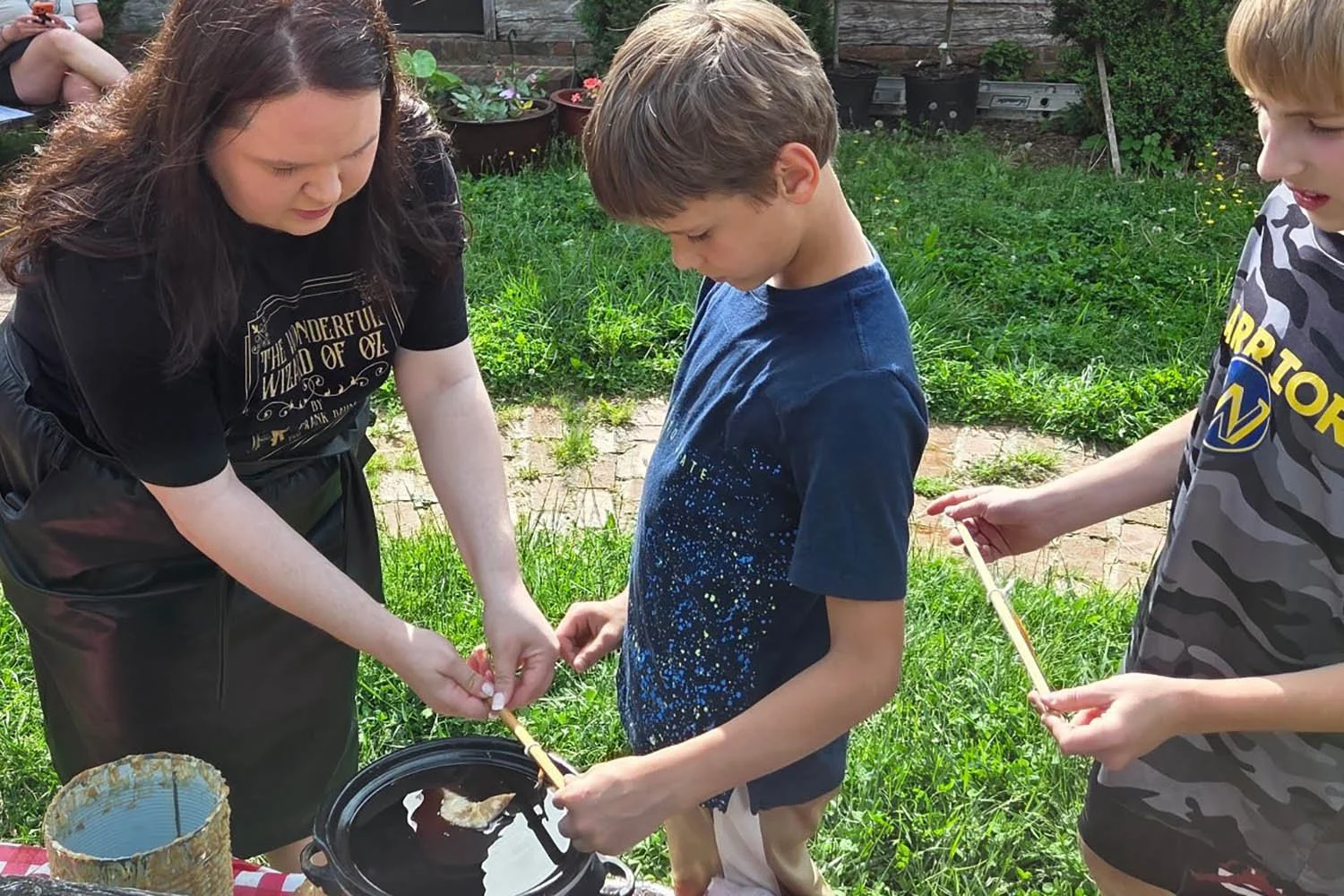
Students will talk about the need for candles during the time of Landon Carter Haynes. A discussion will be held regarding what was involved in getting ready to make candles in the early days, i.e., chopping wood for the fire to heat the wax and preparing the wicks for dipping into the hot wax. A block of beeswax will be passed around for students to smell, noting the aroma of honey which permeates it. Students will observe that candles were made by pouring hot wax into candle molds. Each student will then dip a candle made of a combination of beeswax and paraffin. Holding onto both ends of a dowel holding a wick, students will take turns dipping first into the hot wax & then in a coffee can of ice water to hasten the cooling and then go to the back of the line. When the candle is a medium size, students put their nametag on their candle. Students will take the candles home with them at the end of the session.
-
Historical Significance
Paper is made of plant materials. Many say that the wasp was the first papermaker as the insect used plant materials to build a nest. In Colonial America, the ragman would buy worn out cotton and linen rags. Cotton bolls from the plant are spun and woven into material. Linen comes from the flax plant. These rags were beaten into a pulp using power from water wheels. The pulp was dried on large screens to make sheets of paper.
How Papermaking Relates to Tipton-Haynes
Landon Carter Haynes was the editor of the Tennessee Sentinel, a newspaper published in Jonesborough. The nearest known paper mill of the period was in Knoxville. The Tennessee Sentinel was printed three to four times a year not daily. Paper was very scarce and expensive.
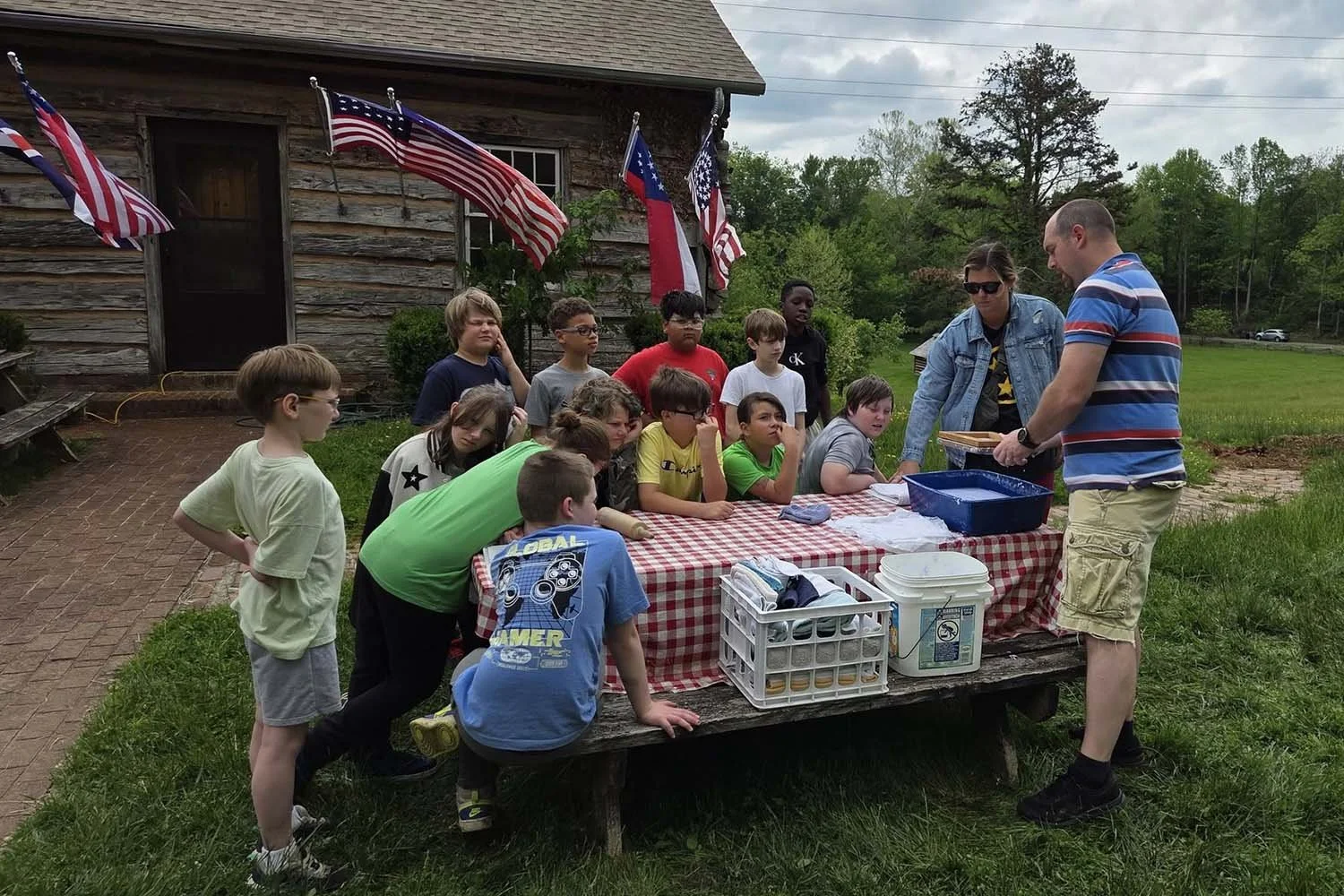
Student Activity
Students will learn about papermaking in the time of Landon Carter Haynes and then make a piece of recycled paper. Imprinted in the wet pulp will be a flower or leaf. Just as people years ago recycled old rags into paper, students will learn of nineteenth century and modern recycling.
-
Historical Significance
Family food in early America was typically prepared in a cast iron pot hung by a hook from a crane in the open hearth. Tableware consisted of wooden trenchers, pottery mugs and pewter spoons. Glassware and china were expensive imports and being extremely breakable and were seldom used. Cooking and serving utensils were in short supply and generally unsatisfactory in terms of weight, durability, convenience and appearance.
When tin ware became available in America in the mid 1700s, it was soon in great demand and was adopted as the basic material from which a vast number of everyday objects were fashioned. Tin was transformed into almost every scarce or non-existent item needed- plates, platters, bowls, dishpans, wash basins, mugs, cups, pots, pans, dippers, ladles, colanders, graters, candle-molds, pails, cake and pie pans, percolators, sieves, funnels, and hundreds of other utilitarian objects
Lanterns, inserts to pie safes, graters, and other objects were punched. The circle, quarter circle, and half circle, as well as the diamond motifs were very common to pierced metal during the early years of our country’s settlement.
How Tin Punching Relates to Tipton-Haynes
In Washington County Tennessee, pie safes and food safes were used in the days before refrigeration. At Tipton-Haynes there is an example of a floor standing cupboard that was used to discourage mice and insects and to keep dust from perishable foodstuffs. These cabinets had tinplate inserts in the doors and sometimes the sides, punched out by the cabinetmaker or tinsmith in varying designs to allow for all circulation. The pie safe at Tipton-Haynes was made by a cabinetmaker in Piney Flats Tennessee in the 1840s.
Student Activity
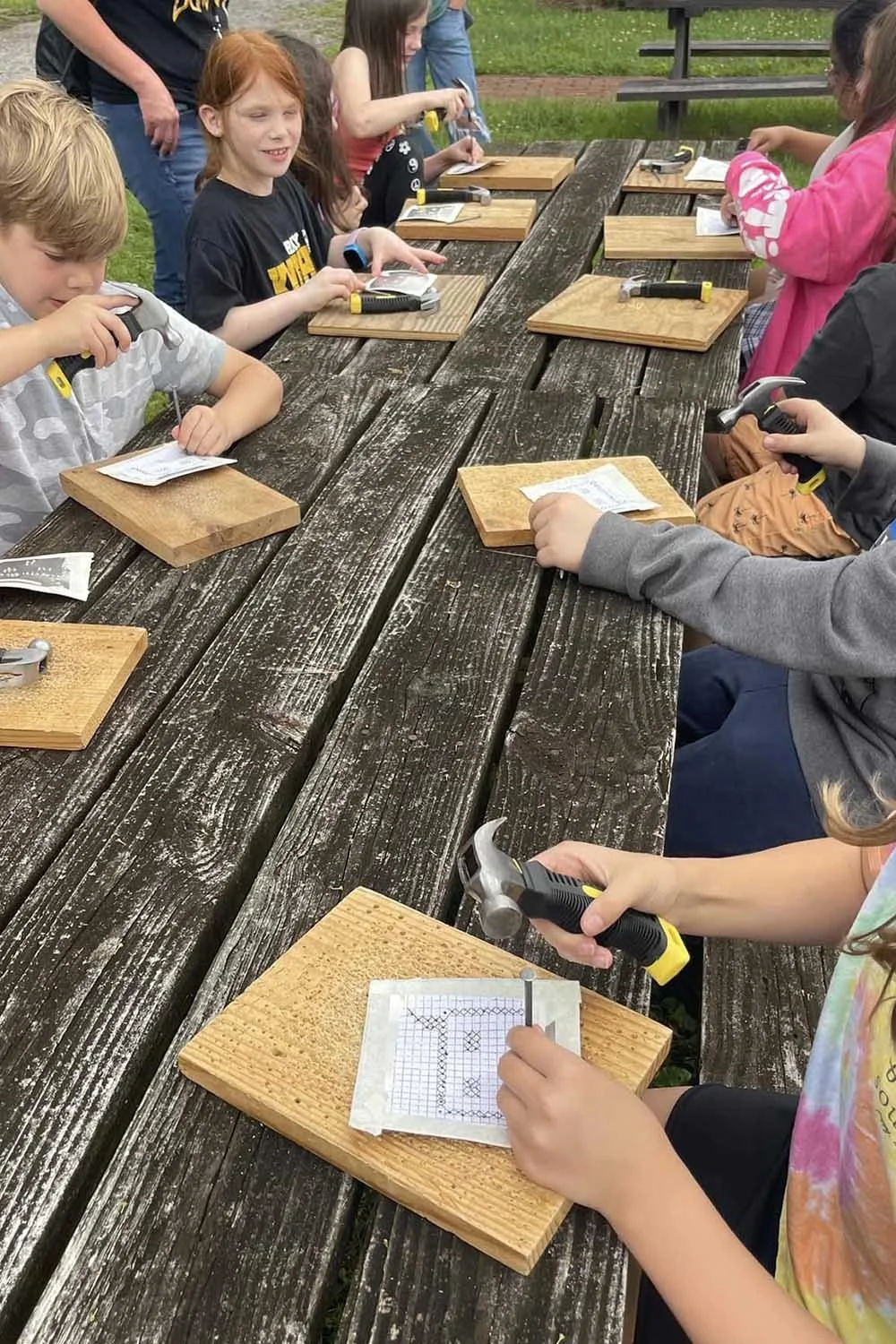
After examining objects made of tin and how tin was used in the 1700s, students will use graph paper to draw their original design. Using a piece of tin (aluminum flashing), they will hammer nail holes following the pattern to create their unique design. After creating their pattern in the tin, students will take home their designed punched tin.
ARTIFACT DISCUSSION AND ANALYSIS
-
Historical Significance
The early pioneers moved to what is now Northeast Tennessee during the mid to late 1700s. Most of these people came from North Carolina and Virginia. The residents that lived in Northeast Tennessee lived in Washington County, Sullivan County, and Greene County. These were the first permanent settlers in this area besides the Cherokee Indians. If the move itself wasn’t hard enough, once they arrived to the property a house needed to be built and a farm needed to be started. The early pioneers lived simply but worked extremely hard. There was no electricity or running water, so cleanliness wasn’t a necessity like it is today. Their homes were heated by wood fires and there was no insulation, making the winters unbearably cold. The food was cooked over the open hearth and could take hours, sometimes all day, to make a meal. Everything is much easier for us now thanks to indoor plumbing, vacuums, and light switches. During the time of the early pioneers, people used what they could make by hand and families worked hard together.
How the Early Pioneer Activity Box Relates to Tipton-Haynes
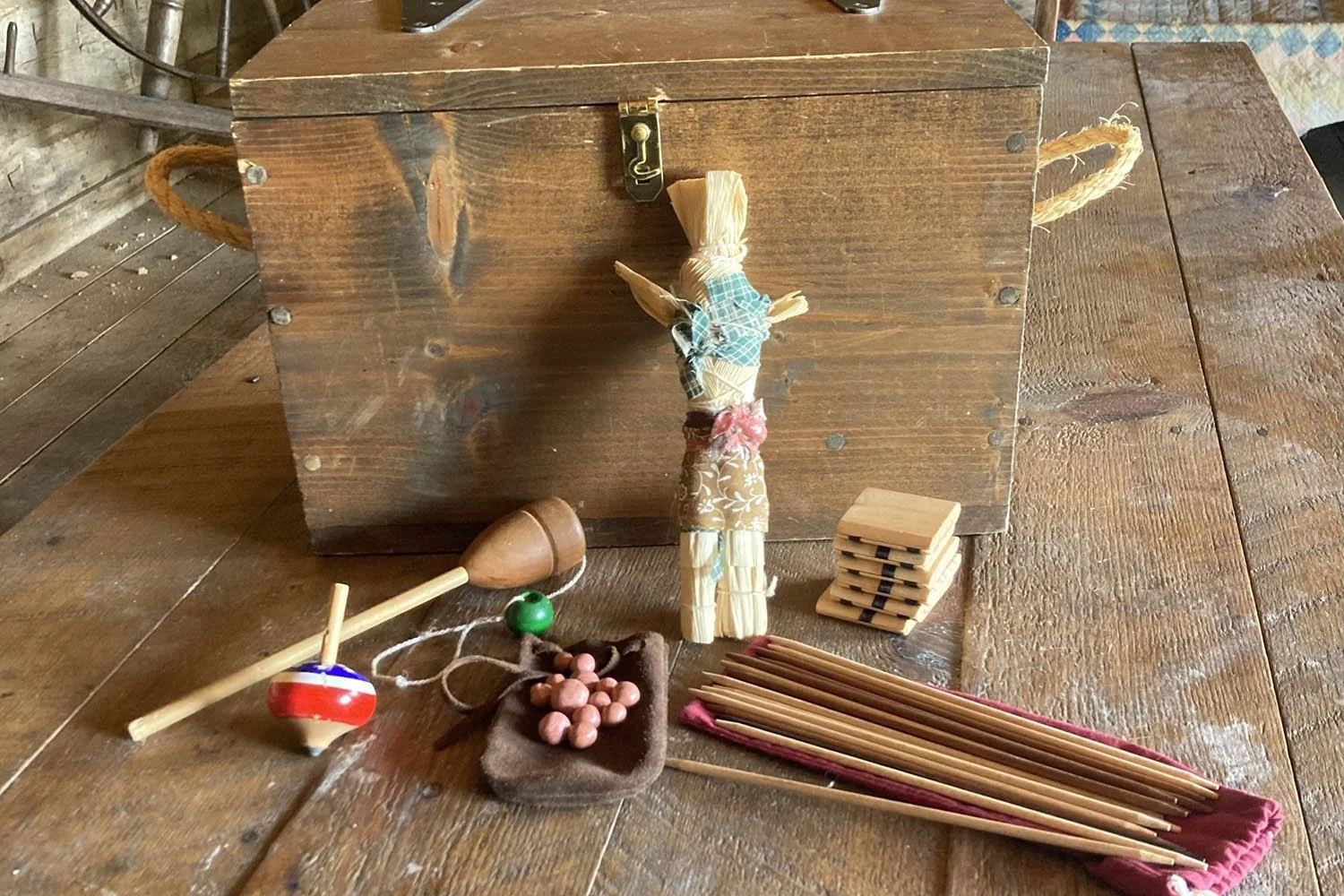
Colonel John Tipton was born in Maryland in 1730. His ancestors moved to Maryland after emigrating from England to Jamaica. He moved to Frederick County in northern Virginia around 1750 where he met his first wife, Mary Butler. He and his family moved from Virginia to East Tennessee in 1783. During this time his 100 acre property was territory of North Carolina. They lived in a one and a half story log cabin with one room downstairs, a kitchen in the basement, and two bedrooms upstairs. Everyday life for the family consisted of working on the farm all day, cooking, sewing clothes, mending shoes, sweeping, and reading in the evening. They would have used the everyday items like those found in this box.
Student Activity
Students will become familiar with the household items that the Tipton family and other families in the area would have used every day. Students will learn about the life of Colonel John Tipton and his family through discussion. Also, students will be taught about the early pioneers who first settled present-day Northeast Tennessee. By using replica artifacts of the time period, students will visually learn about the lifestyle of the Tipton family and other pioneer families. Students will learn how daily life has changed from the eighteenth century to the present day through artifact analysis.
-
Historical Significance
Long before the Native Americans lived in East Tennessee their ancestors, the Paleo-Indians, lived in this region. Based on our archaeological record we know that these prehistoric people were here from 10,000BC – 1,000AD. Around 1,000AD agricultural advancements resulted in the formation of the Native American tribes we know today.
How the Prehistoric People Program Relates to Tipton-Haynes
During the Ice Age there were buffalo, mammoths, giant bears, saber tooth cats and other mega fauna living in East Tennessee. The Paleo-Indians lived in small nomadic groups following and hunting these Ice Age mammals. These people used hunting trails to track the animals and stayed, sometimes for weeks, in caves. As a result of archaeological excavations we know that prehistoric people stayed in the limestone cave located here and that one of these hunting trails ran through what is now the Tipton-Haynes State Historic Site. This path was called the Buffalo Trail and runs parallel to present day Buffalo Road.
Student Activity
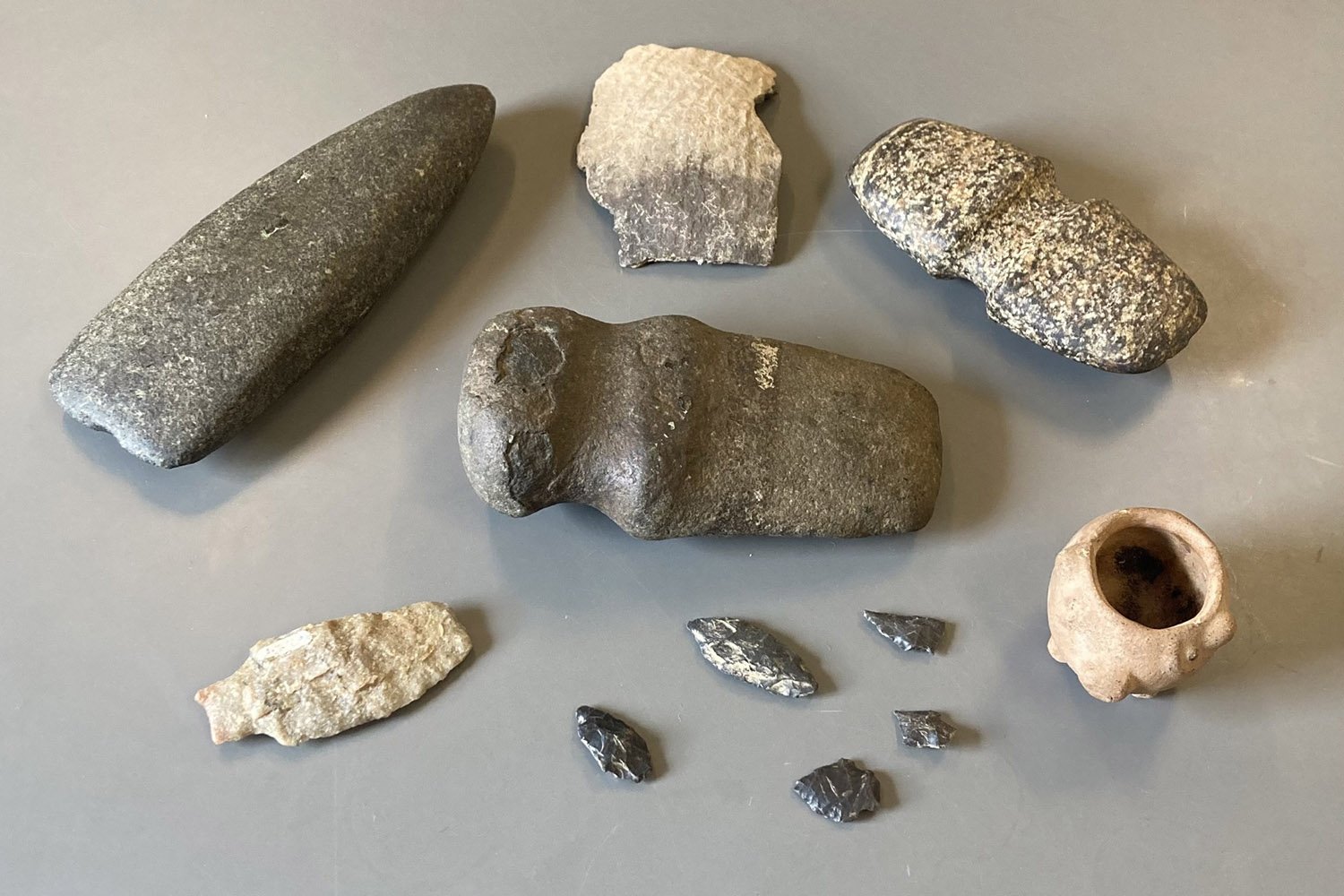
An emphasis is placed on how environmental changes (the end of the Ice Age), technological advances (spear heads, bows and arrows, baskets and pottery) and the advancement of agricultural practices(discovery of farming and the importance of corn) lead to the development of the first communities and the formation of the Native American tribes. Students will learn about the Paleo-Indians by viewing and handling archaeological artifacts, playing board race games with our “Prehistory Timeline” felt board and learning to grind corn by hand.
-
Historical Significance
During the Colonial Era (1492 – 1776), powerful European nations were transfixed on the pursuit of colonies. Admittedly, the primary motive was economic gain, along with a lust for imperial prowess. However, a sub-motive or perhaps secondary interest was scientific curiosity. At that time, science was referred to as “Natural Philosophy” and consisted of modern fields such as botany, geology, and astronomy. While scientists themselves were interested in pushing the bounds of knowledge, the monarchs and joint stock companies wanted to use the scientist’s interest to increase the output of their colonies. Geologists could provide soil and rock information leading to the discovery of precious metals. Astronomers were able to improve navigation. Botanists could improve agricultural production and discover plants that could be useful to the mother country.
André Michaux was one of the many botanists that came to America to study the wealth of plant life. He was sent by Louis XVI of France in 1785 to explore and send back useful specimens. Michaux traveled throughout eastern North America, from Florida into Quebec. He discovered several new species and eventually composed two very influential guides, Histoire des chênes de l’Amérique septentrionale (1801) and Flora Boreali-Americana (2 vols., 1803). In 1796, Michaux was forced to return to France, but he left his legacy through the recognition of the unique fauna of the eastern United States.
How André Michaux Relates to Tipton-Haynes
In Michaux’s travels from 1785-1796, he often was a guest in the homes of local residents. One such local was Colonel John Tipton. In fact, Michaux was a guest on two separate occasions. He spent the night with Colonel Tipton on May 14, 1795 and March 20, 1796. He recorded numerous spring wildflowers around the Tipton home and remarked that the nearby mountains were covered in bloodroot, spring beauty, and trout lily.
Student Activity
Students will learn about the life, travels, and discoveries of André Michaux. A brief focus of Michaux’s stay and study of Colonel John Tipton’s property will be discussed. Along with learning about Michaux, students will learn how science (especially botany) was evolving during the European expansion of the Colonial Era. After a background discussion, students will analysis replica artifacts that Michaux and other botanists would have carried with them during the eighteenth century. Study of local plant life will be conducted in one of two ways. First, students will explore the Tipton-Haynes nature trail and discover and discuss the local and invasive plant life of the site. Secondly, students can play the André Michaux Bingo game that will allow students to visually learn about the plants that Michaux discovered.
-
Historical Significance
Man-powered tools were an essential part of 18th and 19th century life on the farm and in the home. Tools were used in an abundance of ways from building and repairing, to farming, and cooking. They were often difficult to use but increased the efficiency of hand-power. These tools allowed for more comfort and improved survival at all levels of society. While the tools were indeed simpler in nature, their effectiveness is no less as valuable than modern tools.
How Technology & Tools of the Past Relates to Tipton-Haynes
For both the Tipton and Haynes families, tools were extremely important to agricultural success, construction, and provision. The families were generally self-sufficient because there were no near general stores, with the closest one being in Jonesborough or Elizabethton.
Student Activity
The students will be shown some of the tools inside of the historic Tipton-Haynes home and will be asked to brainstorm on their function. Then the tools will be defined for the students at an age appropriate level. Finally, students will be allowed to handle suitable tools and interact with them. Also the tools of the past will be compared alongside with the modern evolution of today. Students will also learn of the technological development of the tools from the past to their modern counterparts of today.
-
Historical Significance
The formation and the demise of the State of Franklin is a complicated and unique part of the history of Northeast Tennessee. Immediately following the Revolutionary War (1775-1783), North Carolina claimed what is present-day Tennessee. In an attempt to help the new nation with its growing debt, North Carolina ceded its western lands (present-day Tennessee) to the national government in order to create new states and new tax revenue. During this period, local leaders meet and declared their independence in August of 1784 and created the State of Franklin. Their goal was to become the 14th state of the Union. Many supported this effort at statehood while others of the area opposed the attempt, one being Colonel John Tipton. Unfortunately for the State of Franklin, North Carolina had receded their cession of its western lands and made Franklin’s attempt an illegal action. For the next four years, the State of Franklin struggled to exist. Before the demise of Franklin, the Battle of the State of Franklin was fought in late February of 1788 on Colonel Tipton’s property between the Franklin militia and local North Carolina loyalists.
How the State of Franklin Program Relates to Tipton-Haynes
On May 15, 1784, Colonel John Tipton bought a 100 acre tract of land that is now the Tipton-Haynes State Historic Site. Soon after settling into his new home, the State of Franklin formed. Colonel Tipton opposed the formation of Franklin and stayed loyal with North Carolina. During the roughly four years of Franklin’s existence, Colonel Tipton represented Washington County in the North Carolina Senate, distributed rhetoric that opposed the Franklin movement, served as colonel of the local North Carolina militia, lead raids into Franklin courts to steal documents, and much more. A three day siege of February 27-29, 1788 and a ten minute battle on the last day of the siege occurred on Colonel Tipton’s property. The Battle of the State of Franklin is the only known armed conflict that occurred between the two opposing forces of the North Carolina loyalists and Franklinites.
Student Activity
Students will learn through discussion the complex history of the formation and demise of the State of Franklin. A brief video will give students more understanding of the controversy of Franklin and the battle that ensue on Colonel John Tipton’s property. Students will learn of Colonel Tipton’s role in opposing the State of Franklin. Also, students will learn about the causes and effects of the Battle of the State of Franklin. After background discussion of Franklin, students will learn the struggles that the State of Franklin faced during its four years of existence through the game of tug-of-war.
-
Historical Significance
The haversack was a vital piece of equipment carried by both Union and Confederate soldiers during the Civil War. The haversack was used to carry all sorts of belongings that soldiers needed to stay alive while in camp or on the march. Daily lives of soldiers would be found within the haversack. Such things included foodstuffs, personal hygiene utensils, communication, recreational activities, and keepsakes that reminded them of home. Without a haversack such belongings of soldiers would have been impossible to carry. Therefore, their haversack, their musket, and their canteen were the most important belongings that a soldier carried with them to keep them alive.
How the Haversack Program Relates to Tipton-Haynes
Robert Haynes and Joseph Haynes, sons of Confederate senator Landon Carter Haynes, were officers in the Confederate army. Nephews of Landon Carter Haynes, Nathaniel Harris and John Frank Gifford also enlisted in the Confederate Army. The Haynes boys, Nathaniel, John, and all young men would have carried a haversack for foodstuffs and personal items. With limited study given to the common soldier of the Civil War, the Haversack Program will allow students an opportunity to learn about Landon’s sons and nephews and about the daily life of soldiers.
Student Activity
Students will be introduced to what was really important to the common soldier of the American Civil War through discussion and artifact analysis. Through discussion, students will become familiarized with the basic background history of the Civil War. Also, students will learn about Confederate Senator Landon Carter Haynes and his sons, Robert and Joseph Haynes, who fought for the Confederacy. After discussing the Civil War and the Haynes family experiences, students will analysis replica artifacts of a common soldier’s haversack. Some of the items that students will be introduced to were luxury items that a lot of times were not available to soldiers. Therefore, students will learn how soldiers depended on the items of their haversacks while they also suffered due to the lack of items in their haversacks.
-
Historical Significance
Slavery is a complicated and evolving part of the history of the United States. Before Tennessee ever became a state in 1796, slavery was already present. The first settlers to Northeast Tennessee brought with them slaves that they previously owned. As the United States expanded during the early 1800s, so did slavery. Slavery prospered as the South grew and shaped into a dominant agrarian society. Northeast Tennessee was not different. Slave owners could be found throughout the area and included historical figures such as John Sevier, Colonel John Tipton, Andrew Jackson, Andrew Johnson, Landon Carter Haynes, and many more. Although slavery was well rooted in Northeast Tennessee, a strong abolitionist ideology developed. One such abolitionist rhetoric was Elihu Embree’s The Emancipator. This newspaper published in Jonesborough during the 1820s favored and appealed for the abolition of all slaves, making it the first newspaper in the United States to proclaim such appeals.
How George Haynes & Slavery in Northeast Tennessee Relates to Tipton-Haynes
Both the Tipton and Haynes families owned slaves during their residency here. Little is known about the slaves of the Tiptons. In the 1860 census Landon Carter Haynes listed three slaves and one slave cabin. Today a log cabin from the mid 1800s replaces and stands atop where the Haynes slave cabin once stood. Two of the slaves of Haynes were females while the male slave, George, was Landon’s half brother.
Student Activity
Students will learn through discussion the history of slavery in Northeast Tennessee and of the Tipton and Haynes families. Through analysis of primary and secondary sources, students will learn in-depth on the slaves of the Tiptons and Haynes. Also, students will discover the sometimes overlooked history of Elihu Embree and his anti-slavery newspaper, The Emancipator.
HISTORIC GAMES
-
Historical Significance
During the eighteenth and nineteenth centuries, toys and board games was an excellent tool for children to learn simple skills. Along with learning, children played games during their spare time after chores and homework. Not able to buy many toys as is the case today, simple toys and games were created during these times. Creativity was learned with such toys and board games of the past.
How Toys & Board Games of the Past Relates to Tipton-Haynes
The size of the Tipton and Haynes families were a moderate compared to other families of their time period. By the time the two Tipton families lived at Tipton-Haynes, their children were nearly all grown. Landon Carter Haynes and his wife Eleanor had four boys and two girls. The Haynes children had an excellent education and during their spare time would have played with toys and board games. During the 2008 archaeological excavation, two marbles from the Haynes time period were discovered. This gives an insight into the possible games that the Haynes children played.
Student Activity
Students will learn the importance of how toys and board games of the past were a source of learning for children of the eighteenth and nineteenth centuries and for the Tipton and Haynes children. After discussing the toys and board games of the past, students will play and learn from the variety of games such as dominoes, marbles, cup-and-ball, and much more.
-
Historical Significance
The use of putting horseshoes on horses goes back to when horses were first domesticated. Domestication robs the wild horse of a wide variety of natural food that acted to harden and condition a horse’s hoof. Riding and using the horse as a pack animal put additional pressure on the hooves. Changing the environment and feed of domesticated horses resulted in hooves being prone to cracking and their feet to injury. Throughout history, man has tried using cloth or animal hide to protect the hooves of horses. Metal shoes were used as early as the 2nd century. The game of horseshoes is based on the old game of quoits when metal rings were thrown at stakes. The circular rings were replaced by a more common item, the horseshoe.
How Playing Horseshoes Relates to Tipton-Haynes
Col. John Tipton (1730-1813) owned well-known thoroughbreds. One Washington County, Tennessee tax records shows that in 1803, Col. Tipton paid on “1 stud, called Diomede.” An article in the Tennessee Historical Quarterly (Summer 1970) states that “During his retirement, John Tipton cared for his estate and bred racing horses. Tipton appreciated fine horses and owned several thoroughbreds, including Diomede which was of the celebrated Diomede imported to Virginia from England.” Other thoroughbreds Tipton owned included Don Quixote, Irish Grey, and Paunch. Horseracing was very popular in Northeast Tennessee in the early years particularly the quarter mile race.
Student Activity
Today at Tipton-Haynes we play sock horseshoes, a much safer game than using iron or steel horseshoes. Students will learn about the history behind horseshoes and the game that developed from shoes of horses. Students will learn about Colonel John Tipton and his love thoroughbreds. Also, students will learn about horseracing of Northeast Tennessee. Students will then learn the rules of sock horseshoes and will be given ample opportunities to throw and score as many points as possible.
FOR 7TH-12TH GRADE ONLY
Activities include Log Cabin to Greek Revival Tour; Limestone Cave Formation and Use by Animals & Humans; George Haynes & Slavery in Northeast Tennessee; André Michaux & Botany; State of Franklin & Tennessee Statehood; and The Haynes Family Perspective of the Civil War.